Tuesday, 31 May 2016

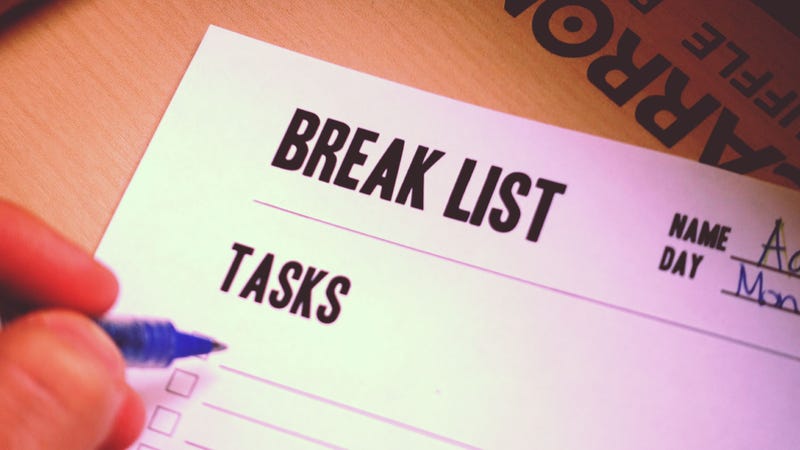
Swap Your To-Do List for a "Break List" to Get More Done


To-do lists keep track of tasks we have to do, but they hardly ever provide actual motivation. A small tweak to your productivity method can solve that problem pretty quickly. All you need to do is start maintaining a “break list” instead, and you’ll find yourself more eager to get things done.

What’s a Break List?


To-do lists, task lists, or whatever you want to call them, all feel one way to me: overwhelming. I throw stuff on there I don’t want to forget, and no matter how much time I spend (or waste?) organizing those lists, they just look like an insurmountable pile of work. Some days I can live with that burden and breeze through the top priorities. Other days—generally the bad ones—I struggle to see any end to the work. After all, by nature to-do lists never end. They go on forever until you die and they don’t care about giving you a break. I thought, what if the lists did care about taking breaks?

Breaks are good. You need them to avoid burnout and keep your sanity. Breaks can turn into elongated procrastination sessions, too, and if you don’t manage them you’ll spend a lot of time fooling around that you should’ve spent getting things done. If taking functional breaks can help and dysfunctional breaks can hurt, you probably ought to manage them, right? To-dos get forgotten or out of hand when they’re not managed, so if you have a to-do list you ought to also have a break list.

Here’s the short definition of a break list: A set of planned breaks with planned times that you can take at any time when you need them. Then check them off when you’re done. You can keep your break list right next to your to do list so you never forget it, and you’ll always have a planned, functional break ready to go whenever you need it. In this post, we’ll explain why this can help you work better and stay motivated, and we’ll show you how to set them up.

Why Do I Need Another List to Tell Me What to Do?

I know what you’re thinking: Another list to go with my to-do list? Why bother? Because lists are awesome, nerdy fun! Even if you don’t think agree, there are other benefits to maintaining a break list alongside your to-do list.

Break awareness leads to motivation. Remember your old friend guilt? Guilt is that fun feeling that you get when you do something wrong, or you don’t do enough. Rather than let your needy pal guilt eat away at your well being, you can use it as a motivational tool. Break lists keep you aware of how many breaks you’ve taken and how long they were for. If you check your break list when you’re lacking motivation and you find you haven’t done anything to relax, it’ll tell you it’s okay to chill out for a minute. If you’ve taken several breaks, you’ll see that you need to buckle down. Sure, you can search your memory for this same type of awareness but it doesn’t carry the same weight as looking at the data right in front of you. The break list gives you a bird’s eye view of your activity so you can make the right choice about your next move when you’re unsure.

Planned breaks increase efficiency. When you decide to stop working for a moment to check Facebook, watch a clip on YouTube, or play a game for a little bit, you have no end goal in sight. If you plan your breaks, however, you can choose specific activities that will last around the amount of time you can spare. Perhaps you plan a break to play one level of your favorite game or to respond to 10 Facebook notifications. If you enjoy those things, you can still do them—but have an end in sight so you get back to work.

Two competing lists gamify your task management in a subtle way. With your to-do list, you check things off as you finish them. This is gratifying, but it’s not really a game. When you take breaks, you might play a game during one of them but that’s not really a game either. However, if you have both a task list and break list side by side you instantly have a competition. Will your work win out or will procrastination? The lists are like scorecards for opposing teams, and the grand prize is your productivity. Tally up the check marks on each side at the end of the day and see if you had a positive, work-favoring ratio. You shouldn’t use this idea to avoid taking breaks, but as a motivational tool to keep the number of completed tasks a decent amount higher than breaks.

Planned breaks help avoid burnout. Maybe you don’t procrastinate much, but you do probably work too much. Perhaps you’ve experienced the horrors of burnout as a result. When we work a lot, sometimes we need reminders to do even the most simple things, like eating. The same goes for taking breaks. If you plan for them, you’re more likely to take them. You already suck at taking vacations from work, so don’t compound the problem by avoiding your breaks as well.

How Do I Set Up a Break List?


Task lists might feel overwhelming and like work, but that’s because they are work. Break lists are about fun things you enjoy, so they’re fun to make. All you have to do is figure out the following:

How long can I take a break? Most of us can spare 15 minutes for a break no matter where we work, so I’d advise keeping all your breaks at least that long unless that doesn’t work for you. Maybe your breaks that be 15 minutes, 30 minutes, or a full hour. Figure out how long your breaks can be under your specific work circumstances and remember those lengths.

What do I like to do on my break? You probably like to read, watch TV/videos, listen to podcasts (like mine!), play video games,exercise, dance, make out in the closet with a coworker, or any number of other enjoyable things. Figure out what you like to do and then break those activities into chunks that fit the time you have. If you have 15 minutes, that’s plenty of time to read a chapter of a book, play a level of a video game, or watch a couple of YouTube videos. If you have a half an hour, you could do any of those things for longer, get in a quick workout, or watch a sitcom. When you’ve got a full hour at your disposal, you can fit in a podcast, get in a full workout, or really do most anything. Pick things you like, sort them by approximate time, and then you’ll have plenty of options for your break list.

Once you know what you want to do on your breaks and how long those things will take you can keep a master list. I strongly recommend that you avoid limiting your breaks by a specific amount of time if you can. A countdown can make it feel a lot shorter and less fulfilling. That’s why I suggest sorting your activities by time in advance and just doing those activities for as long as they take. You might take more or less time than you expect, but so long as you come close to the amount of time you intended to spend, you’ll be just fine.

Every day when you plan out what you want to accomplish, choose items from both your to-do and break lists. Write them out on their own sheets of paper (or digitally, if you prefer), star anything you want to prioritize, and just use those for the day. When you complete a task or break, just check it off. At the end of the day you can compare both lists to see how much you accomplished and how much you allowed yourself to relax and recuperate.

Are There Any Helpful Tools I Should Know About?

Paper and pen works great for both to-dos and break lists. You can also use most to-do list apps, such as Wunderlist, to create your daily task and break lists. But, if you prefer a more specialized and exact route I made and found some stuff for myself that you’re welcome to use in your break list quest:

  • Break List Sheet (8.5x11 Printable PDF)
  • Trello is a webapp that allows for multiple lists in the same view, which is perfect for creating a task list and break list as well as multiples of both. (Check out Lifehacker’s overview for more information.)
  • Use your favorite app! You can use whatever you like to make break lists work for you. If you love Wunderlist, Todoist, Todo.txt, or whatever else, you can use that. While I think having lists side by side helps a lot, if you prefer solo lists you can switch between you can always just add a break list to your current task management setup. One way doesn’t work for everyone, so don’t follow the rules if a few modifications to the break list method I outlined doesn’t suit you.


You really don’t need tools to make this work, but tools can make it more fun for some people. We all have our preferences. Figure out yours and give break lists a try. It can really help you work more efficiently and effectively.

Read the original article here.

It’s Time to Stop Trying to Do it All


Your sanity will thank you.

The Fortune 500 Insiders Network is an online community where top executives from the Fortune 500 share ideas and offer leadership advice with Fortune’s global audience. Beth Brady, CMO of Principal Financial Group, has answered the question: How do you make time for yourself with a hectic schedule?
“I need more hours in a day. If I had even 30 more minutes before this meeting, I could respond to at least six of the high-priority emails in my inbox, return my mom’s phone call, recharge my phone to at least 45%, finalize the monthly report, grab a refill of coffee, and hit the bathroom.” Sound like you? Me too.
But is having more hours in the day really the solution? Time is like an empty closet. Somehow it always gets filled. The real answer is figuring out how to manage the time we do have.
Before your next Outlook reminder message pops up on your screen, here are some steps to turn a hectic schedule into a manageable one:
Say “no”
It can be the most difficult word for us to use. But it’s the most important for being an effective leader. And, if you can’t, surround yourself with people who can. I know when I am saying “yes” too much when my life begins to feel out of control. I feel tired. I am more easily stressed. I have trouble sleeping. Daily cues let me know I have not built breathing space into my schedule. I must assess quickly to get back on track.
A great place to start is with meetings. Figuring out which ones I really need to attend is critical. If it’s about something I need to know, I can always get the notes or a recap. That takes 10 minutes, vs. an hour-long meeting.
Also, for me, events—specifically speaking engagements—can overtake my schedule. They can be a real time-suck if you’re going to do them right, so I’ve learned to be very picky. I have to select the ones I should be doing and delegate the rest to others.
Shake it off
There are many things we all need to shake off every day to be productive—difficult project decisions, unsettling comments from a direct report, an unpleasant meeting with a client, a tough drop-off at school with the kids. Letting these things fester has a toxic effect on productivity. It eats away at your ability to be in the moment, wasting precious time and brilliance that you could be using to make that next big—or little—decision.
In Eckhart Tolle’s book, A New Earth, he tells a parable about two monks. They are walking in silence when they see a girl trying to cross a very muddy road. One monk picks her up, carries her across the road through the mud, and sets her down. The two monks continue to walk in silence for several hours. Finally the one monk breaks his silence: “You shouldn’t have done that because monks are supposed to not even touch women.” My favorite line from the other monk: “Are you still carrying that girl? I put her down hours ago.” Pause. Reflect. Shake it off. Put the girl down. Move on.
Delegate
Someone once told me that when I try to do it all, I am denying a direct report from an opportunity to develop. I can’t do it all. And I certainly can’t do most of it effectively if I am spread too thin. Effective leaders don’t try to do it all. Period. When they do, the work suffers and eventually the inevitable happens: burnout. I’ve hit that wall from serving too many masters a time or two—or 10—in my career. It’s not a good experience.
We all start out being delegated to. As you shift to being a leader, learning how to provide direction and feedback vs. doing the work takes time and practice with ups and downs that impact your schedule along the way. Know what you should be doing vs. what your team can do. Then, get out of the way and let them do it. Your schedule, and sanity, will thank you.
Power down
You need to find things you do that refill your energy store. Power down means spend time doing what you love, not checking off “to-do” tasks you need to get done that you don’t enjoy. It forces you to take time for yourself.
I love to garden, work out, read, play two-dots, and check my FitBit. All let me power down to help me refocus and provide an outlet to clear my mind. Whatever it is for you, do it religiously. It’s critical to a healthy schedule and life.
It seems simple, right? So why don’t we do a better job of managing time? Because bad habits sneak into our lives so quickly and stealthily, that it can be weeks or months before we realize we’re back to a hectic schedule. Using (and practicing) these tips will make you better, happier, and more balanced. That’s a good thing—not only for you, but for everyone.

Read the original article here.

How to Unearth the Root Cause of Your Procrastination – And it’s Not Laziness


Why are you procrastinating? While superficial answers may come up (such as a lack of time management), there is often a real reason why you are procrastinating – and it is not laziness.
To surrender bad habits, understand your emotions thoroughly and be in control of them.
Get to the root of your procrastination. Once you are able to identify why you truly are procrastinating, it becomes much easier for you to stop procrastinating.
Procrastination is a symptom, not the issue.
Procrastination manifests in your mind – the more connected and conscious you are of yourself and your life, the easier it becomes for you to understand where your procrastination truly stems from and subsequently stop it.

A Simple Way to Get to The Root of Your Procrastination

The process of discovering the true cause of procrastination is a process of constant internal probing. Basically, you ask and answer a series of self-administered questions. If this is your first time doing so, it may be difficult, but keep trying and you will get to the root of your procrastination.
First, ask yourself why you are procrastinating.
Then keep probing deeper. And deeper. Ask yourself why, and go in-depth into how you are feeling and what is truly responsible for those feelings. Or ask yourself: Why does that matter?
Continue until you hit the jack pot. How would you know if you have hit the jack pot? You’ll just know it – something in your heart will go “Click!” and for that temporary moment, you’ll feel enlightened about this new discovery of yourself.

Common Root Causes of Procrastination

1) Insecurity about one’s abilities
Most of the time, we are just afraid because of a lack of self-confidence in various aspects of our lives/ character/ looks/ relationships. We go into a vicious cycle of self-doubt and negativity.
2) A subconscious fear of something negative happening
For instance, I realized that I have not cleaned my room in weeks. Here is my thought process to get to the root cause of my procrastination:
“Why am I not clearing up my room?” ->”I have no time” -> “That’s not really true, you have time to be on social media” -> “I don’t see cleaning my room as something important” -> “I am scared of being unproductive and not focusing on tasks that’s important”
The truth was that cleaning my room was an important task, but I didn’t want to to it because I’ve always associated cleaning as a very unproductive activity. Add that to the fact that I hate being unproductive, and you have the reason why.
The root reason for the same task will differ from person to person.
3) The activity has some form of implied meaning to you which you associate with negatively.
My friend has the same problem of not packing up his room, but due to reasons that are very different from mine.
“Why are you not clearing up my room?” -> “I am too lazy” -> “Why are you too lazy to clean your room?” -> “I am immature to do such adult tasks” -> “What?” -> “I guess I just don’t feel like I’m mature enough to do such adult tasks like cleaning”
When I probed deeper, I realized that it was because he saw packing his room as a very “adult” thing to do – and as someone who has just reached the age of being a legal adult – he was not ready to be seen as an adult. (That is, he is insecure about his maturity).

How About You?

What’s one task which you are procrastinating really badly on? Think of just one.
Then, I want you to think of why you really are holding it off.

Read the original article here.

8 Secret Habits of Highly Successful People (That Most People Don’t Know About)


A lot has been written in the past about habits of highly successful people. But beside the obvious, there are secret habits highly successful people have which most people don’t really know about. Though very busy for instance, the president of the United States finds time to play golf, while many working dads hardly find time for a family dinner.
Similarly, there are many things these people do habitually to achieve more in little time. And somehow they are able to also maintain a healthy balance in their health and family life. Let’s take a look at some of these below:
  1. They are Early To Rise and Early To Plan

The early morning hours are what I call, ‘think time’. Successful people know this, and they maximize it. For instance, they never check their emails first thing in the morning. This is the reason they don’t have hassled days nor do they appear rushed.
To be successful, take a while to think, plan, meditate and pray early in the morning. This way you start your day with a clear picture of what the day will look like. Keep it reasonably flexible, but keep it clear.
  1. They Prioritize and Schedule their Work

Deadlines have a way of sifting your work and separating the trivial from the essential. Having deadlines set for each task has a way of reducing the lull in your brain when you consider all you have to do and helps you focus on a task per time.
Successful people understand this and they always work with schedules.
To practice this habit, you need to start prioritizing properly by asking yourself, “If I had just a year left to live, will I be spending time on the things I am doing today?” It works every time.
  1. They find the Balance between Hard Work and Too Much Work

Work doesn’t get done if nobody is doing it. And if you have got a lot of work to do, it stands to reason that you have to work a lot.
Working hard is good. It is necessary for successful people to push themselves and to learn to cope with a little stress and discomfort. A little stress is necessary for peak productivity so long as it doesn’t become “distress”. Finding the balance is a function of our body systems and capability. Successful people understand this. They work hard, but they don’t do it to the point of breaking down.
  1. They take Effective Breaks throughout the Day

One of the typical mistakes many people make when faced with a rather daunting volume of work is to push back their recess times till there is nowhere else to push it to. A survey has shown that employees who tend to take 17 minutes of break time for every 52 minutes of work are more productive.
Our minds ability to focus on a task is like a muscle. It wanes with time and constant exertion. What this means is that the longer we focus on a task without a break, the less we achieve.
Taking a break is one thing, but making it effective is a whole other story.
Most successful people make it a habit to do something different that doesn’t remind them of work during their breaks. They don’t spend their free time immersed in work. Richard Branson’s favorite sport for instance is kite boarding.
So, take a break before you break down. Take a walk, jog, go see some nature, grab a coffee or some chocolate. Watch a funny video or catch up with an episode of a movie if your break can take it.
  1. They use Stress Deflectors

For many people, some soft music in the background of the working environment is all they need to overcome any volume of work and still not be stressed. For others, productivity comes to its peak when they work in a natural environment, like a garden. And when they can’t go all out to embrace nature, they put flowers and green plants in their offices or get a fish pond.
Do the same thing. Find out what helps you deflect stress and maximize it for success. This may be all you need to help you work better and achieve a lot more.
  1. They Delegate and Team up

When you have done all you humanly can, you can only achieve a fixed amount. The simple reason is because you are human. To be successful usually means achieving an amazing lot in little time and this requires some insight into the art of teamwork.
Successful people are people that trust others to do what they cannot afford to do themselves. They pay people to do what they cannot do and they work with people who know what they do not know.
Bill Gates, doesn’t know a quarter of all the technical and administrative stuff that goes on in Microsoft. And he doesn’t do a lot too, he simply delegates effectively. He doesn’t have to know so much. He just has to know what he has to know.
  1. They take Virtual Vacations and Lots of Sleep

Most successful people understand that it is necessary to have productive nights, if you are going to have productive days. And the productivity of your night is measured by how much sleep you get at night, seeing as the night is meant for mainly that.
It also helps to make sure that your sleeping time and the early hours of the morning coincide with a virtual vacation and a technology free period. Turn off your phone, no beeps from IM’s or emails.
This way you can actually rest while sleeping.
  1. They are disciplined

Self-discipline is one of the qualities that greatly differentiates successful people from most other people. Success requires discipline and applying these tips will bring success. So you might want to explore ways of building your discipline levels.
Success doesn’t fall on people…generally success is cultivated. Do your best to cultivate these habits too. I hope you enjoy the process.
Read the original article here.

Monday, 30 May 2016

If You Think Building Habits Can Help You Reach Goals, This Will Change Your Mind


Usually when we want to achieve something, we try hard to build some habits, as we’re told that habits are the fundamentals of success. However, if we examine the functions of different parts of our brains, habits turn out to be something that hinder us in achieving our goals rather than assisting us. When we’re practicing our habits, we’re actually using the primitive brain, which is not the preferred one for achieving goals…Here’s why.
First we need to understand how our primitive brain works.

The “Primitive Brain”

The human primitive brain, otherwise known as the limbic system, has developed over millions of years. Our ancestors had three straight forward goals that they needed to keep in mind if they were going to survive. These goals were:
  1. Find food
  2. Find a mate
  3. Stay safe from predators
Humans had only their superior intelligence to rely upon. Unlike other animals we did not have great strength or speed, sharp teeth or the like. The primitive brain developed in such a way to help us achieve these three goals.
When we saw the possibility of acquiring food we experienced high energy levels that prompted us to go after the food. When the potential to reproduce presented itself we experience great desire, and when we felt that we had pushed ourselves too hard we felt the desire to rest.
So our primitive brain is constantly telling us to seek out food and sexual pleasure; it also tells us to rest rather than motivating us to do some exercise.
On the contrary, the modern brain tells us to control ourselves…

The “Modern Brain”

The modern brain, otherwise known as the pre-frontal cortex, developed after many years trying to survive on one’s own. People decided that it would be easier to achieve the three goals of survival if they worked as a group; thus tribes were created.
As humans started to cooperate and work as a group they needed to learn how to cooperate and work in unison. This meant that it was necessary to learn control over certain actions. Social rules were developed, such as:
  1. Do not steal someone else’s food
  2. Do not take someone else’s mate
  3. Respect others’ property and do not try to steal their shelter
To respect these rules and make sure we did not break them we need to develop a new type of intelligence. This intelligence would be used to control the basic desires of our primitive brain. The new intelligence may be referred to as self-control.
So it is up to the modern brain to override these primitive drives and to steer us towards higher goals. We constantly experience a fight between short-term desires and long-term goals. It is up to the modern brain to consider the consequences of our primitive desires and to make decisions that will help us in the long term.

So How Do Habits Hinder Us?

Habits are formed in the primitive brain and as such do not require thoughts. When we try to use habits to attain our long-term goals we are, in effect, telling our short-term brain to take charge. And the short-term primitive brain has different aims to the long-term modern brain. So the result will not be in keeping with our higher aims.
When you set out to help your modern brain achieve its goals do not aim to create new habits.
You may have tried meditating at some point in your life and no doubt you experienced the difficulties associated with maintaining focus on one particular thing, for example your breath. Trying to force yourself to concentrate on something will often prove futile. This is because we are fighting a reward-based learning process that is caused by positive and negative reinforcement. A habit is formed when, for example, we see food, eat it and decide that it tastes good. For human being calories equal survival. We remember the rewards we experienced after we ate the food and repeat this process. It goes as follows: trigger behavior reward; see food, eat food, feel good and repeat. Then what should we do instead of building habits?

Use Curiosity to Break Unwanted Habits

In an experiment researchers told people instead of forcing people to, for example, quit smoking, they told people to be curious about their habits. They actually told people to smoke and be really curious about it. One of the participants said: “Mindful smoking: smells like stinky cheese and tastes like chemicals,YUCK!” She had decided on a cognitive level that smoking was bad for her. She was no longer captivated by her habit.
When the prefrontal cortex is not engaged we tend to fall back into old habits. When we are tired, stressed or involved in making tough decisions we can easily fall back into our old ways. Curiosity helps us take notice of our experience rather than trying to get rid of the experience (habit).
As it says in the article titled: Using Curiosity to Break Bad Habits: “What does curiosity feel like?  It feels good. And what happens when we get curious? We start to notice that cravings are simply made up of body sensations — oh, there’s tightness, there’s tension, there’s restlessness — and that these body sensations come and go. These are bite-size pieces of experiences that we can manage from moment to moment rather than getting clobbered by this huge, scary craving that we choke on.”
When we are curious we stop fearing our habits and reacting automatically to our habitual patterns. We activate our modern brain and are able to reflect more effectively on what we are doing in a scientific and isolated way. So next time you experience an unwanted habit or find yourself focused on short-term goals try to engage your long-term modern brain and become curious about what you are doing.
Read the original article here.

Prioritize Your Projects to Get More Done - Factoring Your Projects with the Prioirity Triangle


This is a guest post by “Captain D.”  At eighteen, when most young lads were fighting angry professors in college, Captain D was fighting the waves of the roaring North Atlantic.  He is now in command of one of the largest Ocean liners in the world. In his blog The Soul Creator, he details specific workable strategies to be a winner in life. 
We often get hit by different jobs at a rate higher than we can work them out.
The Bosporus Strait is the narrow stretch of water between The Marmara Sea on the Turkish coast and Black sea bordering Russia, and one of the most painfully congested areas to navigate on earth.  The sea ahead seemed choppy and unruly. Wind speed was picking up fast.
As Commander, I had several quick decisions to make. Things on deck needed to be secured. The Pilot needed to disembark before high waves hit us, and before it became impossible to get him off the vessel. The possibility of slowing down to avoid impending disaster had to be assessed. Traffic ahead of us gave little room to maneuver. All departments needed to be informed so that they can start preparing for bad weather immediately. All this in a matter of minutes.
Too many things at once? Well, that’s just another day for us out at sea.

Too Many Things at the Office

Here is where you are in life and this is where you are in your profession:
  • You have several jobs and a given time to complete them.
  • Every job is important. Every minute is important too.
  • Yet, ALL the jobs are not important ALL the time.
One of the essential aspects to manage time is to prioritize. It is what separates winners from whiners.
There is no point complaining about too many jobs – too many targets – too many things to prove. No one can focus on too many things at once. Yet there are people who achieve everything. That’s because they prioritize.
What is the theory behind correct prioritizing? Here is the take of a Captain who has made his living out of multi-tasking.
Here is the real arithmetic behind setting priorities.

The Priority Triangle

Every job you will ever do and every decision you will ever take – big or small – can be categorized by three parameters.
 Ease factor: Easy to Difficult
 Urgency factor: Short time (Urgent) to Enough time(Not so Urgent)
 Consequence factor: Low Consequence to High Consequence
Something may lead to a high consequence but you may have one hour to solve it. The other thing may be half as important but you may have just 5 minutes to take a call on that. The second one should rise up on your priority chart! That’s the one which requires your immediate attention. Once you get that out of the way you can get back to solving the more important issue at hand.
Similarly if an easy job is pushed back a bit that does not mean you do not understand its importance. It means at that moment you are prioritizing.
If you evaluate your project on a scale of one to five on each of the above parameters, the priority of a job will be given by:
Priority Quotient = Ease factor  x  Consequence factor  x  Urgency factor 
Lets assume a job of Consequence factor 5, which is easy (Ease factor 1) and you have time for it (Urgency factor 1) has a Priority (1 x 1 x 5) = 5.
At the moment it is of lesser priority than a job with medium consequence (consequence factor 2) which is not so easy (Ease factor 4) and is urgent (Urgency factor 5). This one has a Priority value of = 2 x 4 x 5 = 40.

Prioritize Projects, Get More Done

You could always compromise with life. Let the smaller things go because you were busy doing that one big thing. But you don’t really need to. With a bit of practice your mind instinctively starts prioritizing appropriately.
A trained mind works like a computer, filtering out unwanted information in real time as it keeps coming in, and working on what is absolutely essential at the moment. Simply by setting the correct priorities you could be leagues ahead of others around you.
Don’t compromise on your priorities, and you will find ways to get more things done.
Read the original article here.

One Hard Thing You Have to Do to Be Happy, Healthy and Successful


Think about the most common problems we deal with in our lives – from laziness to lack of exercise to unhealthy diets to procrastination, and so on.
In most cases, problems like these are not caused not by a physical ailment, but by a weakness of the mind – a weakness that urges us to avoid discomfort.
Discomfort is a form of pain, but it isn’t a deep pain – it’s a shallow one.  It’s the feeling you get when you’ve stepped outside of your comfort zone.  The idea of exercising in many people’s minds, for example, brings discomfort – so they don’t do it.   Eating green vegetables brings discomfort too.  So does meditating, or focusing on a difficult task, or saying no to others.  Of course, these are just examples, because different people find discomfort in different things, but you get the general idea.
The bottom line is most of us don’t want to be uncomfortable.  So we run from discomfort constantly.  The problem with this is that, by running from discomfort, we are constrained to partake in onlythe activities and opportunities within our comfort zones.  And since our comfort zones are relativity small, we miss out on most of life’s greatest and healthiest experiences, and we get stuck in a debilitating cycle.
Let’s use diet and exercise as an example…
  • First, we become unhealthy because eating healthy food and exercising feels uncomfortable, so we opt for comfort food and mindless TV watching instead.
  • But then, being unhealthy is also uncomfortable, so we seek to distract ourselves from the reality of our unhealthy bodies by eating more unhealthy food and watching more unhealthy entertainment and going to the mall to shop for things we don’t really want or need.  And our discomfort just gets worse.
Amazingly, the simple act of accepting a little discomfort every day, and taking it one small step at a time, can solve most of our common problems, and make our minds happier, healthier and stronger in the long run.
Now, let me give you some examples of how I’ve experienced this in my own life…

Strengthening the Mind… One Small, Hard Step at a Time

Years ago, when I was incredibly focused on weight lifting and physical strength training, I gradually learned that you can’t be truly committed to any goal if you have a weak mind that’s unwilling to be uncomfortable.  To combat this, I wrote two simple questions on two different post-it notes and stuck one on my bathroom mirror and the other inside my gym locker:
  • How many workouts have you missed because your mind, not your body, told you that you were too tired?
  • How many workout reps have you skipped because your mind, not your body, said, “Nine reps is enough.  Don’t worry about the tenth”?
To this day, the answer to both questions is probably hundreds for most people, including myself.  Weakness of the mind is a real dream killer, and the only way to fix this weakness is daily practice.
Far too often we think that mental strength is all about how we respond to extreme circumstances.  How did she perform on stage during that nationally televised event?  Did he bounce back after his business associate betrayed him and bankrupt their company?  Can she keep her life together even after suffering from a major, debilitating bodily injury?
There’s no doubt that extreme circumstances test our bravery, determination and mental strength, but what about common, daily circumstances?
Just like every muscle in the body, the mind needs to be exercised to gain strength.  It needs to be worked consistently to grow and develop over time.  If you haven’t pushed yourself in hundreds of little ways over time, of course you’ll crumble on the one day that things get really challenging.
But it doesn’t have to be that way.
Choose to go to the gym when it would be more comfortable to sleep in.  Choose to do the tenth rep when it would be more comfortable to quit at nine.  Choose to create something special when it would be more comfortable to consume something mediocre.  Choose to raise your hand and ask that extra question when it would be more comfortable to stay silent.  Prove to yourself, in hundreds of little ways, that you have the guts to get in the ring and wrestle with life.
Mental strength is built through lots of small, daily victories.  It’s the individual choices we make day-to-day that build our “mental strength” muscles.  We all want this kind of strength, but we can’t think our way to it.  If you want it, you have to do something about it ritualistically.  It’s your positive daily rituals that prove your mental fortitude in the long run.
The bottom line is that when things get difficult for most people, they find something more comfortable to do.  When things get difficult for mentally strong people, they find a way to stay on track with their positive daily rituals.  (Angel and I build positive, life-changing rituals with our students in the “Goals and Growth” module of Getting Back to Happy.)

How to Get Comfortable with Being Uncomfortable

The idea of building up enough mental strength to be OK with discomfort may sound daunting, but it’s really not.  It’s relatively easy when you take it one step at a time.  This is a discovery Angel and I made many moons ago when we were trying to dig ourselves out of a hole and get our lives back on track.
We started to accept a little more discomfort by trying to live with less physical possessions and less debt, but we hated the feeling of not being able to buy things when we wanted them.  At first, it was truly uncomfortable to resist that forceful urge.  Our minds resisted, tried to run from this discomfort, and tried to make up all kinds of excuses for buying stuff we didn’t need.
But we learned to be one with the discomfort, and stay the course, by spending just a little less every week.  When we did, gradually, spending less got easier and easier.  Our world didn’t end – it just got better.  We were a little uncomfortable for a while, and then we weren’t anymore.
Then I watched this same process transpire with my daily workout regimen.  I didn’t want to lift weights because it was too hard.  My mind made up a bazillion excuses.  I found ways to avoid the gym.  But then I caught myself, and gradually gave in to the discomfort, a little bit at a time, and it wasn’t as hard as I imagined.  I lifted weights, and grew to love it.  Then Angel saw my progress, and she started working out too.
Angel and I repeated this process for improving our diet, reducing our alcohol consumption, conquering procrastination, working through adversity, and more.
Getting comfortable with discomfort – and gradually building up our mental strength in the process – has easily been the biggest key to our long-term happiness and success.
If you can learn to get comfortable with discomfort, your life will be filled with fewer limits and a lot more opportunities.
Here are some tips to get you started:
  • As discussed above, try embracing discomfort in small doses by building positive daily rituals to support your goals.  If you’re averse to exercise, for example, take a 5-minute walk to the end of the block and back every morning before breakfast.  Don’t overthink it – just put on your walking shoes and go.  You probably won’t like it much at first, and that’s OK.  You don’t have to like it to feel good about getting it done.  Believe it or not, before I started with weights, this is how I started working out at the very beginning.  And now I love it.
  • Pay attention to your tendency to avoid discomfort.  What tasks, goals, or issues have you been avoiding simply because they make you feel a little uncomfortable?  What good ideas have you been rejecting?  What problems do you have that stem directly from an unwillingness to accept some discomfort?  What have you allowed your mind to make excuses about?  Become aware of your mind’s weakness with discomfort, and see if you can start taking small steps forward, one by one.  (Angel and I discuss this further in the “Adversity” chapter of 1,000 Little Things Happy, Successful People Do Differently.)
  • Focus on the full extent of your emotions when you’re feeling uncomfortable.  Are you angry, or scared, or worried, or sad?  Instead of ignoring those emotions, face them.  Embrace them, accept them, sit with them.  For example, if you catch yourself procrastinating with a difficult task, eliminate the distractions, sit with the task, and don’t shift to something else.  Just be there with that uncomfortable feeling of dealing with the difficult task in front of you.  How does it feel?  Are you in deep pain?  Or are you really OK?  Take a deep breath.  And then take the next smallest step.
  • Set yourself up with tiny discomfort challenges.  Simply do slightly uncomfortable things at regular intervals:  Say hello to strangers.  Be sensitive and tell someone how much they mean to you.  Say no to people when you know you should.  Get to the gym.  Eat kale.  Skip the Starbucks.  Etc.
Follow the tips above and you will gradually learn that discomfort can be a very good thing – when you’re uncomfortable, you’re trying new things, you’re learning, you’re expanding, you’re becoming more than you ever were before.  Discomfort, in most cases, is a sign that you – mind and body alike – are growing stronger… and growing closer to becoming the person you always dreamed you could be.

Your turn…

How have you been avoiding (necessary) discomfort in your life?  What’s the next smallest step you need to take to make progress?  
Read the original article here.