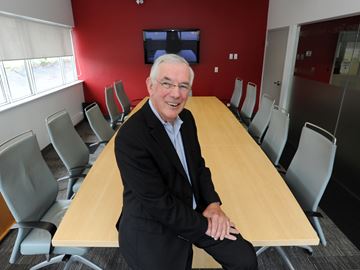
“We cannot remember things that haven’t happened yet,” explains Sherwood, 70. “So, the brain constantly reminds itself, ‘I have to call Joanne Friday.’ Maybe several times a day that comes up in your brain until the event occurs. That is brain traffic.”
He sketches a graph with several spikes to illustrate the neurological interruptions this provokes.
But Sherwood claims that if you learn to reduce those intellectual reminders – the average cerebrum has 40,000 to 60,000 thoughts per day – the mind becomes clear and the soul rests at night.
Teaching people this practice is Sherwood’s passion. He claims he can save you an hour of working time each day. He shares the path to this mental freedom at seminars he has been conducting since 1983 when he quit his job to launch this entrepreneurial business.
Sherwood, born in New Brunswick, and was an executive at Mississauga-based Dun & Bradstreet. That’s when he noticed a sudden and remarkable change in another senior leader who revealed he had just taken a time management course offered by a global company called Priority.
Sherwood investigated and was so impressed, he quit his position and stationed himself downstairs in his Port Credit basement to work on his own Priority franchise.
He reports that within five years he had a million-dollar-a-year business on his hands. His wife was a partner in the project.
His services and prices vary, but he charges in the range of $500 + per person for the daylong seminar and follow-up. He calculates that if a salaried employee makes $50,000 a year and improves productivity just five minutes per day, the course will pay for itself within a year.
One per cent of a typical workday is five minutes, and one per cent of $50,000 is $500.
One of the cornerstones of his method is to check your emails no more than once an hour.
“The difference in terms of your work is profound,” he claims. “Everything in life is not a crisis.”
To support his claim, he asks whether 20 years ago when busy professionals had personal assistants and no inboxes, did the assistant walk into the boss’ office every 20 minutes ringing a crystal bell, waving an unopened piece of paper and demanding he respond immediately?
He says the answer is “no” because such behavior is highly disruptive.
Sherwood also has a strong opinion about To Do lists.
In short, they are bad ideas. This is because they are not prioritized. Hardworking people tend to work on the least important items first to get them crossed off the paper.
“They are not a focused and prioritized list for the day, so they are not ideal,” he explains.
“First things first,” he demands of his clients. “Focus and finish.”
Another important element of his system is utilizing the potential of Outlook Express to organize, prioritize and create peace of mind.
“It is a truck when it comes to work and organization,” he says. “And few people know its full capabilities.”
In particular, it assists the absent-minded, a trait in which there is no shame, he says. He claims that there is actually an inverse relationship between IQ and the ability to remember things to do – meaning bright minds are so busy working with the extensive knowledge they have, they just are not thinking about future events. The stereotype of the absent-minded professor is rooted in fact.
This forgetfulness leads to what Sherwood calls the Flat Forehead School of Management. He refers to the thunk of the heel on our hand gives the forehead when an important chore is remembered too late.
He also consults with knowledge-based businesses on acquiring the appropriate tools for efficiencies.
One look around the newsroom he is sitting in and he questions why reporters still have hand-held telephone receivers. Headsets are inexpensive and they free up two hands to work on the computer during an interview.
“A headset could be justified with a minute saved per day,” he says. He calculates that based on a $50,000 a year salary and 230 days of work, employees earn one dollar a minute. With headsets being inexpensive, they would pay for themselves quickly.
However, he gives information industries a bit of a break for not operating efficiently because they were not around in full force 100 years ago.
Back then, he says, Canada had a population of eight million. One out of two people were farmers and the life expectancy was 47 years. Most other workers laboured in factories, which thrive on efficiency. Knowledge-based businesses were rare.
He quotes management consultant and author Peter Drucker who said that particular sector is 20 to 40 years behind factories in terms of efficiency.
“I like to say that the top of your desk is the factory floor raised 30 inches, says Sherwood. “You have to keep it organized. Factories are obsessed with ways to improve productivity.”
Material needs to be disposed of, delegated, done immediately, or date activated for later attention. He calls these The Four Ds.
The average person spends four minutes per hour, 33 minutes a day, and three weeks a year looking for stuff, according to Sherwood.
Although he focuses on using technology to become more efficient, he concedes that sometimes old-fashioned instruments get the same result.
“There are many tools,” he concedes. “Use the tool with the minimum complexity. Use your common sense to determine what is the simplest. A paper calendar might be fine, but don’t be a Luddite.”
What is the benefit of all this?
“If you have a better way to work, you have a definite advantage. Pure and simple – our clients get more done,” he claims. “They have one extra hour per day.”
He adds clients often confide in him that they sleep better at night.
But still, that artsy type in the corner sometimes isn’t enticed by promises of general efficiency. After all, how does that help you paint or dance better?
Well, Sherwood explains that reduced brain traffic is reported to increase creativity. And with that piece of information – combined with the promise of a better night’s rest – the creative skeptic in the corner sometimes decides to face the day head on and join Sherwood in the great adventure of time management.
Read the original article here.

No comments:
Post a Comment